
A missing legal guarantee notice or GARAN label breaches the national rules that transpose the Consumer Rights Directive. Each Member State sets the penalties, which must be effective, proportionate and dissuasive (Art. 24(1)). In coordinated EU enforcement actions under Regulation (EU) 2017/2394, the maximum fine must be at least 4% of the trader’s annual turnover in the Member States concerned, or at least EUR 2 million where turnover information is not available. There is no case law on the notice yet.
Not legal advice. This page summarises the EU framework to the best of our knowledge (as of 9 October 2026). Penalties, competent authorities and procedures are laid down in national law and differ between Member States; we only describe the details for Germany. There is no case law on the legal guarantee notice yet. If you receive a letter from an authority, a competitor or an association, have it checked by a lawyer before you sign or pay anything.
Is a missing notice a breach of EU consumer law?
Yes. Since 27 September 2026, the legal guarantee notice has been part of the information a trader must give consumers before the contract: Art. 6(1)(l) of the Consumer Rights Directive (CRD) for online shops and other distance contracts, Art. 5(1)(e) for physical shops. If a producer offers a free commercial guarantee of durability of more than two years on the entire good and makes this information available, the GARAN label is added (Art. 6(1)(la) and Art. 5(1)(ea) CRD). In an online shop, the GARAN information must also appear directly before the order (Art. 8(2) CRD).
Member States had to adopt their transposing measures by 27 March 2026 and apply them from 27 September 2026 (Art. 4(1) Directive (EU) 2024/825). A missing notice is therefore a breach of the national consumer law that applies to the contract. Who exactly must show the notice is explained on the page Who must show the EU guarantee labels?
Who enforces the obligation?
Enforcement is a matter for national law. Member States must ensure adequate and effective means of enforcement (Art. 23 CRD). These include rules under which the following bodies, as determined by national law, can take action before the courts or the competent administrative authorities:
- public bodies,
- consumer organisations,
- professional organisations.
In some countries, competitors can also take action; in Germany, for example, through warning letters (Abmahnung) under the Unfair Competition Act (UWG). Which body is responsible in your country and which procedure applies follows from the national law that transposes the directive. We do not describe national rules outside Germany on this page.
Is there a fine for a missing legal guarantee notice?
Possibly. The directive does not set amounts itself: each Member State lays down the rules on penalties, and they must be effective, proportionate and dissuasive (Art. 24(1) CRD). The directive is only specific about one situation:
- Penalties are imposed in a coordinated enforcement action under Regulation (EU) 2017/2394, that is, a joint action by the authorities of several Member States against a widespread infringement.
- The maximum fine must then be at least 4% of the trader’s annual turnover in the Member States concerned (Art. 24(3) CRD).
- Where information on annual turnover is not available, the maximum must be at least EUR 2 million (Art. 24(4) CRD).
These figures describe the minimum level of the maximum fine in such coordinated actions, not a typical fine for a single shop. Otherwise, the amounts and the competent authorities depend on national law. In Germany, for example, a fine for missing mandatory information is only possible in such a coordinated action (see below).
Germany: warning letters (Abmahnung) and fines
Germany placed the obligation in Art. 246 and 246a of the Introductory Act to the Civil Code (EGBGB) and § 312j of the Civil Code (BGB). In online retail, the notice is mandatory information under Art. 246a § 1(1) sentence 1 no. 11 EGBGB. Under German unfair competition law, information that consumers must not be denied under laws transposing EU directives counts as material (§ 5b(4) UWG). Withholding it is unfair under § 5a UWG; § 3a UWG (breach of a statutory provision) may also apply. This gives rise to claims for removal and injunction (§ 8(1) UWG), which are typically asserted by a warning letter. Whether a missing notice is serious enough to be actionable (the “Spürbarkeit” threshold) is still unclear for this new obligation; for mandatory information, courts often assume it is.
Under § 8(3) UWG, competitors, trade associations, qualified entities and chambers are entitled to take action. Restrictions apply to competitors, not to associations:
| Who | Basis | Particularities |
|---|---|---|
| Competitors | § 8(3) UWG | No reimbursement of the costs of the warning letter for information duties in electronic commerce (§ 13(4) no. 1 UWG); no contractual penalty on the first warning letter if you normally have fewer than 100 employees (§ 13a(2) UWG) |
| Trade associations | § 8(3) UWG | these restrictions do not apply |
| Qualified entities (e.g. consumer associations) | § 8(3) UWG; also the Injunctions Act (UKlaG) | these restrictions do not apply; action under the UKlaG, details unclear, most likely via § 2 UKlaG |
| Chambers | § 8(3) UWG | these restrictions do not apply |
There is no separate German fine just for the missing notice. Art. 246e § 1(2) no. 4 EGBGB covers missing mandatory information under § 312a(2) and § 312d(1) BGB, but only for a widespread infringement within the meaning of Regulation (EU) 2017/2394, and only in the context of a coordinated enforcement action under Art. 21 of that regulation. The Federal Office of Justice (Bundesamt für Justiz) is responsible (Art. 246e § 2(5) and (6) EGBGB). The fine is then up to EUR 50,000; for traders with an annual turnover of more than EUR 1.25 million, up to 4% of annual turnover, or alternatively up to EUR 2 million (Art. 246e § 2(2) and (3) EGBGB). For the individual shop that has forgotten the notice, the UWG is the more realistic route of enforcement in Germany.
All details for Germany: Gewährleistungslabel fehlt: Abmahnung und Bußgeld (in German).
Are there already court rulings?
No. To our knowledge, there is no case law on the harmonised notice or the GARAN label yet; the obligation has only applied since 27 September 2026. How authorities, competitors and associations will act is open.
Questions about correct implementation that could matter in a dispute are also open, for example whether a collapsible display of the notice is sufficient or which language version a shop must show. The background is on the page Regulation 2025/1960 explained.
What to do if you receive a letter
Stay calm, but act. Some general principles apply to any warning letter or notice from an authority:
- Take the deadline seriously
Such letters usually set a short deadline. Do not let it pass; get advice straight away. - Do not sign without checking
An enclosed cease-and-desist declaration can bind you for a long time. Do not sign it before it has been checked, and do not pay hastily. - Ask a lawyer
Have a lawyer check whether the claim is justified, who is making it and whether costs or a contractual penalty may be demanded at all. - Add the notice correctly
Whatever the outcome, make sure the official notice is in your shop. The checklist below helps.
How to reduce the risk
The risk drops considerably once the notice is shown correctly. Check these points:
- The Commission’s official notice is used, not recreated and not modified (Annex I, note 1, Regulation 2025/1960).
- It is in colour; black and white is not allowed online (Annex I, note 5).
- It is clearly visible before the purchase, in a prominent manner, and legible at standard display size.
- A clickable link to the QR code’s destination is provided (Commission guidelines, p. 15).
- For products with a producer’s guarantee of durability of more than two years, the GARAN label appears next to the product picture and directly before the order (Art. 8(2) CRD).
- Notice and label also appear in the order confirmation (guidelines, p. 20).
- The commercial guarantee statement is provided on a durable medium at the latest on delivery (Art. 17(2) Sale of Goods Directive (EU) 2019/771).
- You do not advertise “2-year legal guarantee” as a special benefit. Presenting rights given to consumers in law as a distinctive feature of the trader’s offer is always unfair (point 10 of Annex I to the Unfair Commercial Practices Directive 2005/29/EC).
Where the graphic belongs in the shop is explained on the page Placement of the legal guarantee notice. For the basics, see the guide Legal guarantee notice.
How do I close the gap on Shopify?
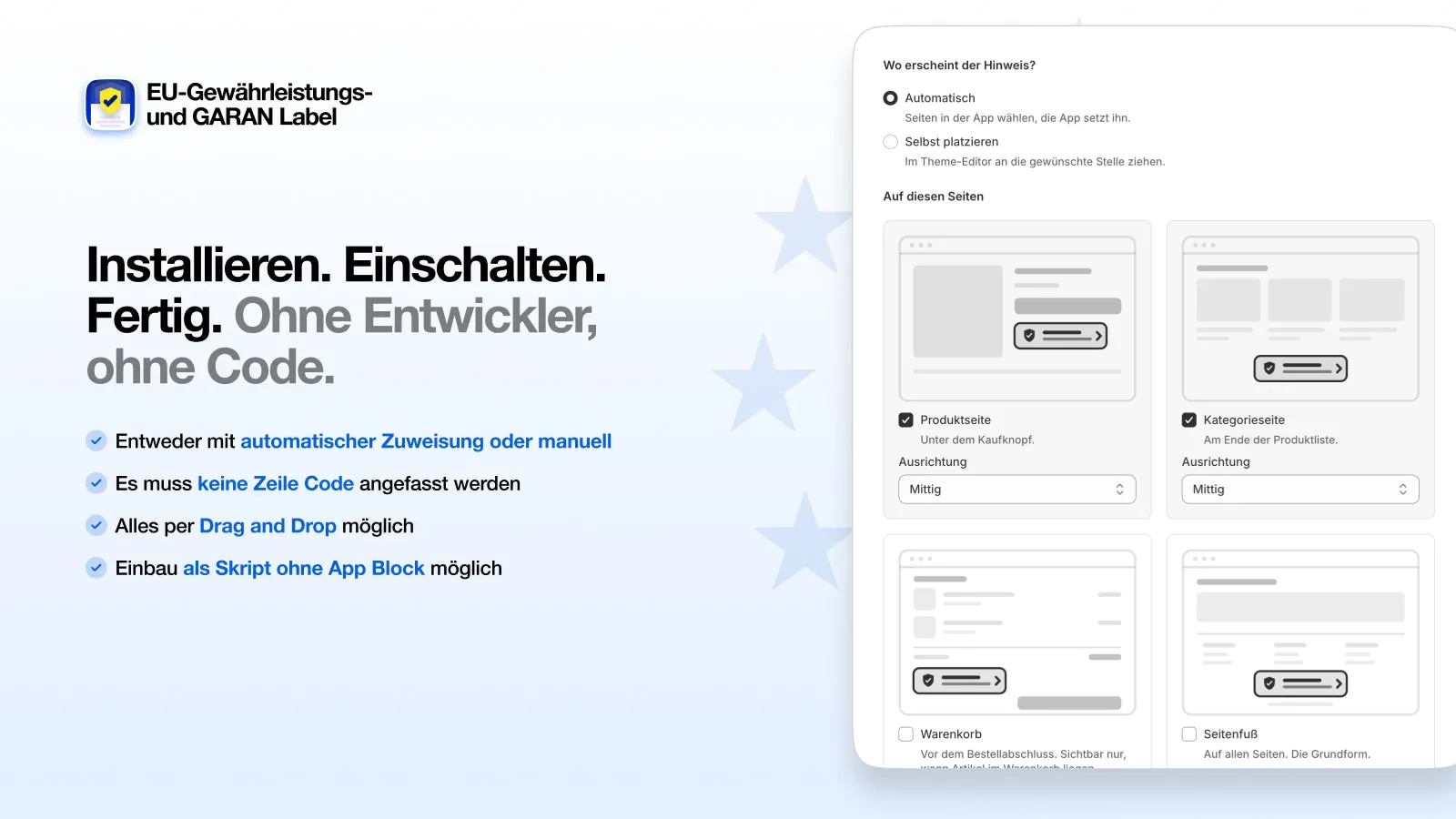
On Shopify, the app EU-Gewährleistungslabel, GARAN covers the points of the checklist: it shows the Commission’s original graphics unmodified and in colour, in all 24 official languages matching the shop language. Placement is automatic on the product page, collection page, in the cart, in the cart drawer and in the footer, or by drag and drop in the theme editor. You set up GARAN labels per producer and product; the graphic with a PDF download and the commercial guarantee statement go into the order confirmation via a block that you add once to the e-mail template. More on the page Shopify app. For other shop systems there is the free widget.
Frequently asked questions
What happens if the EU legal guarantee notice is missing?
The trader breaches the national rules transposing the Consumer Rights Directive. Public bodies, consumer organisations and professional organisations, as determined by national law, can take action (Art. 23 CRD); in some countries, such as Germany, competitors can too. There is no case law on the notice yet.
How high is the penalty for a missing notice?
Each Member State sets the penalties; they must be effective, proportionate and dissuasive (Art. 24(1) CRD). In coordinated enforcement actions under Regulation (EU) 2017/2394, the maximum fine must be at least 4% of annual turnover in the Member States concerned, or at least EUR 2 million where turnover information is not available.
Can competitors take action against a missing notice?
That depends on national law. In Germany, competitors, trade associations, qualified entities and chambers can demand an injunction under the Unfair Competition Act (§ 8 UWG). Competitors cannot claim the costs of the warning letter there (§ 13(4) no. 1 UWG); associations can.
Does the GARAN label carry the same risk?
Yes, where it is mandatory: if the producer offers a free commercial guarantee of durability of more than two years on the entire good and makes the information available to you. In an online shop, the GARAN information must also appear directly before the order (Art. 8(2) CRD).
My notice has been missing since 27 September 2026. What now?
Add the official notice as soon as possible, in colour and unmodified. Check whether products with a producer’s guarantee of more than two years need a GARAN label. If you have already received a warning letter or a notice from an authority, have it checked by a lawyer before you respond.