
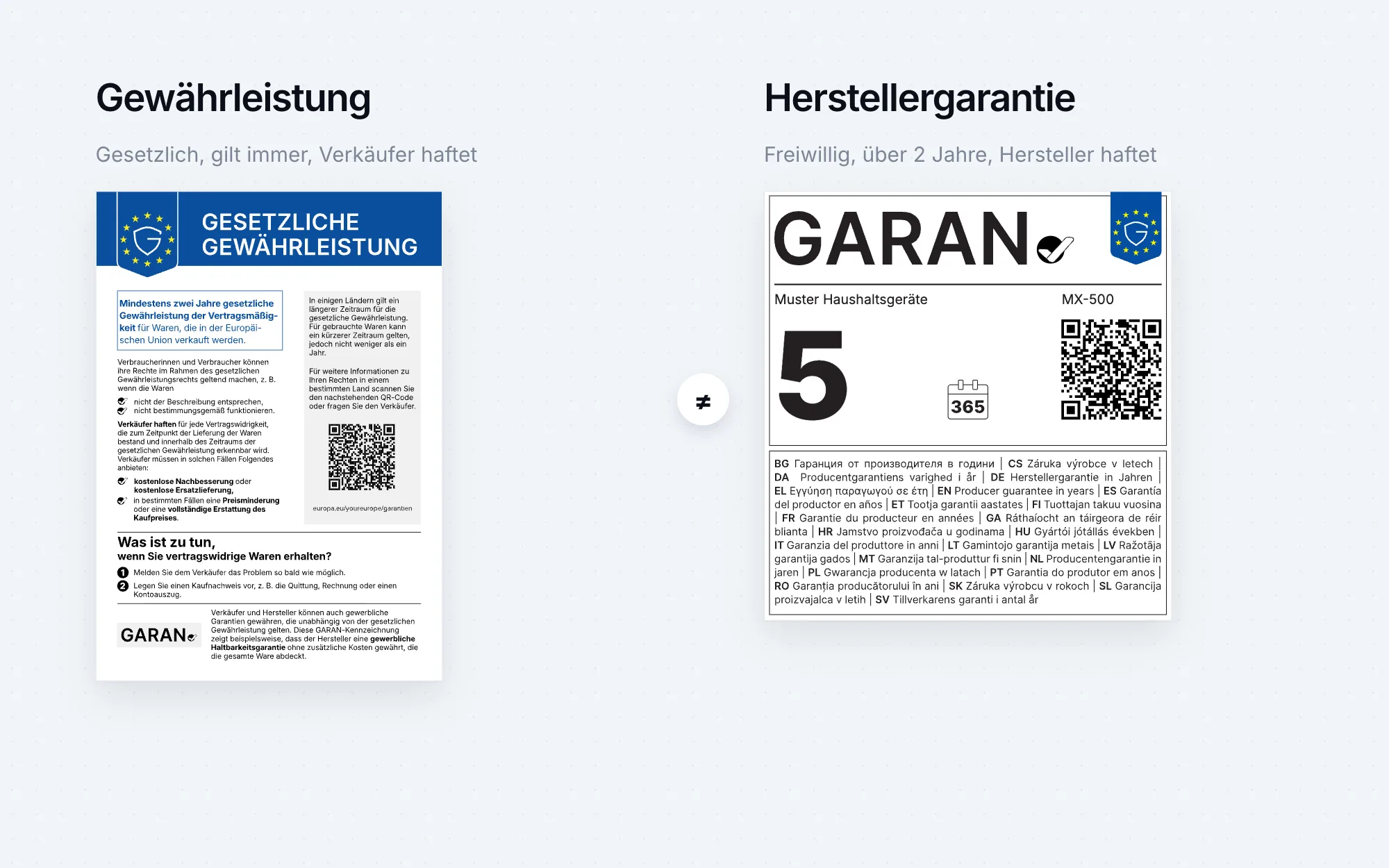
The legal guarantee is a statutory right of the buyer against the seller for defects that already existed on delivery, for at least two years from delivery under EU law. A commercial guarantee is a voluntary additional promise. Since 27 September 2026, the legal guarantee notice stands for the legal guarantee, and the GARAN label only for the producer’s commercial guarantee of durability.
The legal guarantee and the commercial guarantee are often treated as the same thing in everyday language, including in product texts and customer e-mails. Since 27 September 2026, mixing them up has a new consequence for traders: each now has its own official graphic, and if you swap them, you show the wrong thing. This page explains the difference from a trader’s point of view and shows where the legal guarantee notice and the GARAN label fit in.
What is the difference between the legal guarantee and a commercial guarantee?
The legal guarantee is set out in law; a commercial guarantee is a voluntary promise. The legal guarantee of conformity applies whenever a consumer buys goods from a trader, without anyone having to offer it. It is directed against the seller and covers defects that already existed at the time of delivery.
A commercial guarantee only exists if someone promises it: the seller, the producer or a third party. What it covers, how long it runs and whether it costs anything is set out in the guarantee statement. The statutory rights remain unaffected (Art. 17 of the Sale of Goods Directive).
Implementing Regulation (EU) 2025/1960 expressly calls the legal guarantee of conformity and the commercial guarantee of durability “two independent types of guarantees” (recital 2). That is why there are two graphics with two different triggers.
Legal guarantee, commercial guarantee and guarantee of durability compared
The table puts the three terms side by side. The third column, the commercial guarantee of durability, is a special form of commercial guarantee and the only case the GARAN label is meant for.
| Legal guarantee of conformity | Commercial guarantee | Commercial guarantee of durability (GARAN) | |
|---|---|---|---|
| Basis | Law: Art. 10 et seq. of the Sale of Goods Directive (SGD) | voluntary promise: Art. 2(12), Art. 17 SGD | voluntary producer promise: Art. 17(1) SGD, Art. 2(14a) Consumer Rights Directive (CRD) |
| Who is liable | Seller | Seller, producer or third party | Producer, directly to the consumer |
| Covers | a defect that existed on delivery | whatever the guarantee statement promises | that the goods keep their functions and performance through normal use |
| Duration | at least 2 years from delivery (Art. 10(1) SGD) | free to choose | free to choose; label only required above 2 years |
| Cost | free of charge | free to choose, can be paid | for the label: at no additional cost |
| Mandatory graphic | harmonised notice (legal guarantee notice), whenever goods are sold to consumers | none | GARAN label, if all conditions are met |
What is the legal guarantee?
The legal guarantee is the consumer’s right to receive goods in conformity with the contract from the seller. It is based on the Sale of Goods Directive (EU) 2019/771, which every member state has transposed into its national law. It costs the customer nothing and does not have to be agreed separately.
Duration: the seller is liable for any lack of conformity that exists on delivery and becomes apparent within two years (Art. 10(1) SGD). Member states may set longer periods (Art. 10(3) SGD), and some EU countries do; the directive only sets the minimum of two years. In Germany, for example, the period for movable goods is two years from delivery, and five years for a building and for building materials that were used in a building and caused its defect.
Remedies: the buyer can first ask for repair or replacement. Only after that do a price reduction or termination of the contract come into play (Art. 13 SGD). This is exactly the sequence the legal guarantee notice summarises: free repair or free replacement, and in some cases a price reduction or full reimbursement.
How does the reversal of the burden of proof work?
If a defect becomes apparent within one year of delivery, it is presumed to have existed at the time of delivery (Art. 11(1) SGD). So in this first year the customer does not have to prove that the goods were faulty from the start; the trader would have to show the opposite.
The Sale of Goods Directive allows member states to extend this period to two years (Art. 11(2) SGD). Germany, for example, has kept one year. After that the presumption no longer applies, but the legal guarantee itself continues until the end of the two years.
German law also adds its own presumption for guarantees of durability: if a defect occurs while the guarantee is running, it is presumed to give rise to rights under the guarantee. The EU directives do not contain this rule.
What applies to second-hand goods?
The legal guarantee also applies to second-hand goods, and the legal guarantee notice is mandatory for them too. The difference: where national law allows it, the period can be shortened to no less than one year, but only by agreement between seller and consumer (Art. 10(6) SGD).
The official graphic covers this itself. It says that for second-hand goods a shorter period may apply, “but not less than one year”. So if you sell second-hand goods, you show the same notice as a trader selling new goods. Whether and how you can validly shorten the period is a matter of your contract terms and belongs in the hands of your legal adviser.
What is a commercial guarantee?
A commercial guarantee is any voluntary promise that exists in addition to the legal guarantee (Art. 2(12), Art. 17 SGD). Typical examples are a trader’s guarantee, a producer’s guarantee on individual components or a paid guarantee extension. The guarantor decides content, duration and price.
Three rules bind the guarantor nonetheless:
- Advertising is binding. If the guarantee statement is less favourable than the advertising, the advertising applies (Art. 17(1), second subparagraph SGD).
- Guarantee statement on a durable medium. At the latest on delivery, the consumer must receive a statement with a clear reminder of the free statutory rights, which are not affected by the guarantee, the name and address of the guarantor, the procedure, the goods concerned and the terms of the guarantee (Art. 17(2) SGD).
- Formal errors do not cost the customer anything. The guarantee stays binding even if the statement does not meet these requirements (Art. 17(3) SGD).
There is no mandatory graphic for ordinary commercial guarantees. The GARAN label must expressly not be used for them (Commission guidelines, p. 29).
What is a commercial guarantee of durability?
A commercial guarantee of durability is a guarantee under which the producer is directly liable to the consumer for repair or replacement throughout its entire period (Art. 2(14a) CRD; Art. 17(1) SGD). It promises that the goods keep their required functions and performance through normal use; that is the definition of durability in Art. 2(13) SGD.
The GARAN label is only mandatory if all conditions are met together (Art. 6(1)(la) CRD):
- Guarantee from the producer
not from the trader. - At no additional cost
a paid extension does not count. - For the entire good
not just for individual components (recital 31 of Directive 2024/825). - More than two years
exactly two years is not enough (recital 30 of Directive 2024/825). - The trader has the information
the producer makes it available; the trader does not have to research it (recital 26 of Directive 2024/825).
It is still open how unlimited or “lifetime” guarantees and guarantees that require registration should be treated. The label only knows years, and the rules do not say whether registration counts as an “additional cost”.
How do the legal guarantee notice and the GARAN label fit in?
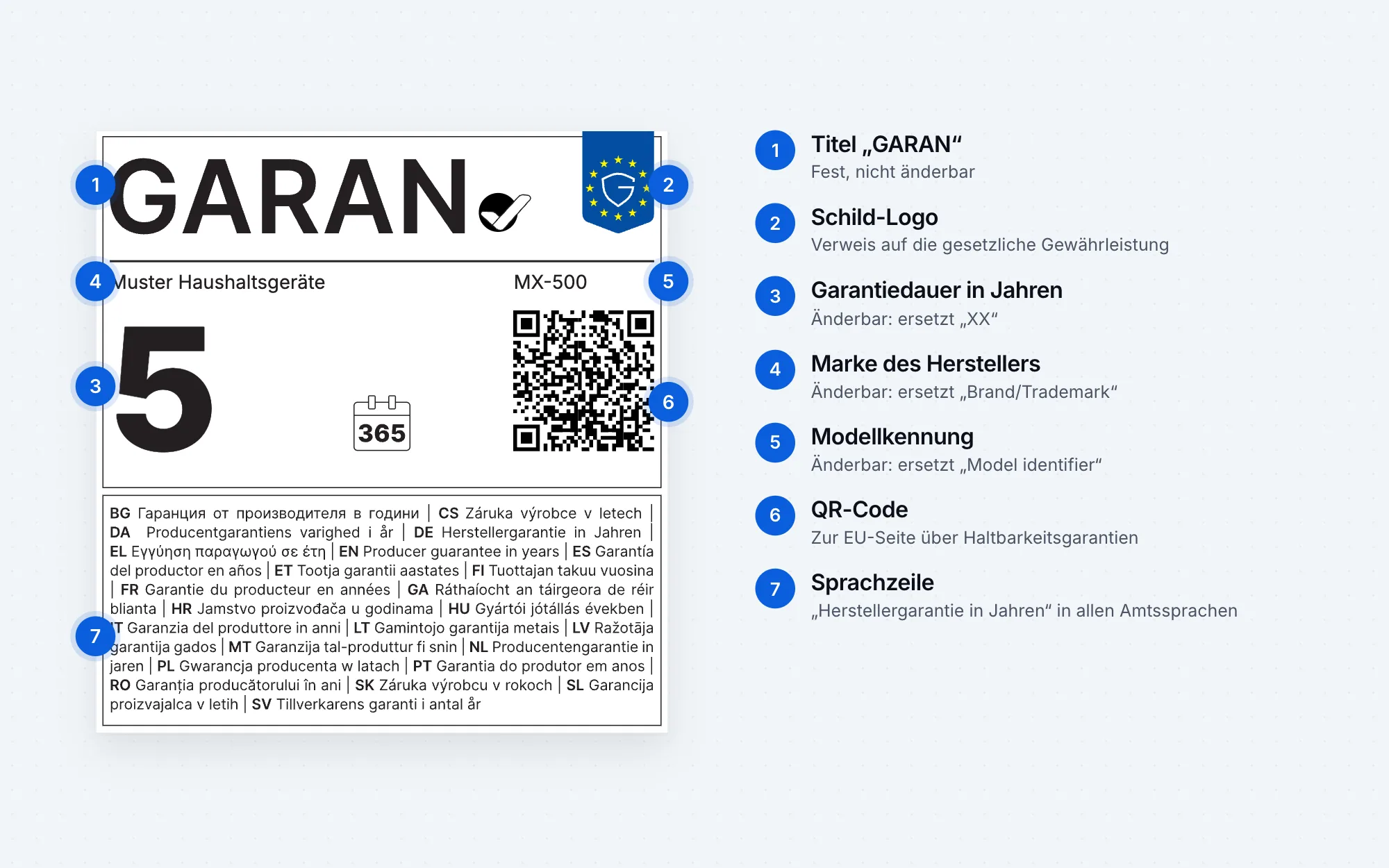
The legal guarantee notice stands for the legal guarantee, the GARAN label for the producer’s commercial guarantee of durability. Both have been mandatory since 27 September 2026, but for completely different reasons.
Legal guarantee notice
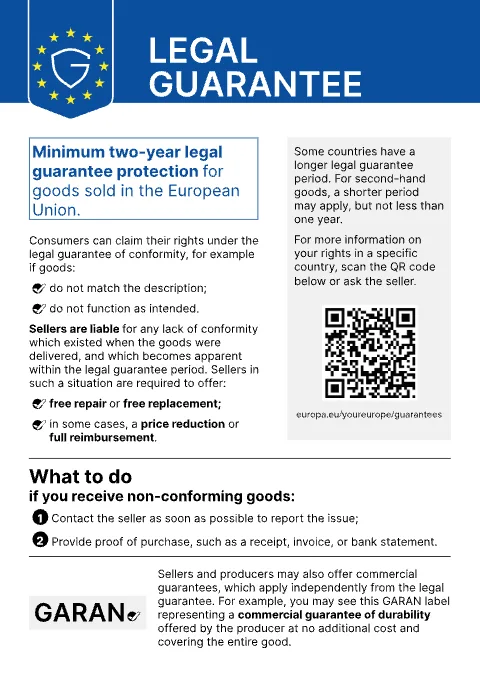
Officially the “harmonised notice on the legal guarantee of conformity” (Annex I of Implementing Regulation 2025/1960). Mandatory whenever goods are sold to consumers, because the legal guarantee applies to all goods (recital 28 of Directive 2024/825).
GARAN label
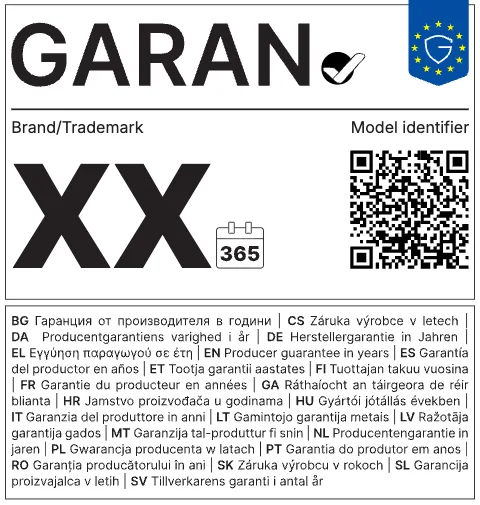
Officially the “harmonised label for the commercial guarantee of durability” (Annex II of Implementing Regulation 2025/1960). Only mandatory if the producer offers a guarantee of durability of more than two years and makes that information available.
The GARAN label itself contains a visual reminder of the legal guarantee, the shield logo (Annex II, note 1(II) of the implementing regulation). Conversely, the legal guarantee notice refers to commercial guarantees and the GARAN label. Both graphics make it clear: the guarantee comes on top, it replaces nothing.
For your shop this means: the legal guarantee notice goes prominently before the order, for example on the product page, in the cart or in the footer. The GARAN label goes directly next to the picture of the good that has the guarantee (recital 28 of Directive 2024/825) and directly before the order (Art. 8(2) CRD). Details are in the guide on placement.
On Shopify, the app EU-Gewährleistungslabel, GARAN does this for you: it shows both official graphics unmodified, the GARAN label only for the products and producers you set it up for, and adds the graphic with a PDF download and the guarantee statement under Art. 17(2) SGD to the order confirmation.
Can I advertise “2-year legal guarantee”?
We advise against it. Under point 10 of Annex I to the Unfair Commercial Practices Directive 2005/29/EC, “presenting rights given to consumers in law as a distinctive feature of the trader’s offer” is always unfair. If you highlight “With us: 2-year guarantee!” as a benefit, you are advertising exactly such a statutory right.
The official legal guarantee notice, on the other hand, is something you show because the law requires it; it presents the legal guarantee as what it is: a right that applies to all goods. The problem is your own advertising claims that sell the obvious as an extra, for example in banners, product titles or lists of benefits.
You may advertise a genuine commercial guarantee, but carefully. Advertising is binding: if it promises more than the guarantee statement, the advertising applies. According to the guidelines, you may only use the GARAN label in advertising for products that are actually covered, and where several products are shown, not in a way that suggests all of them are covered (guidelines, section 3.4).
Common misconceptions about the legal guarantee and commercial guarantees
Traders come across the following assumptions again and again. All of them are wrong or risky.
| Misconception | What is correct |
|---|---|
| “The legal guarantee and a commercial guarantee are the same thing.” | They are “two independent types of guarantees” (recital 2 of Implementing Regulation 2025/1960). |
| “The notice is only needed for products with a guarantee.” | It is a reminder of a right that applies to all goods (recital 28 of Directive 2024/825). |
| “Every guarantee needs the GARAN label.” | Only the producer’s free guarantee of durability for the entire good for more than two years. The label must not be used for other guarantees (guidelines, p. 29). |
| “Trader guarantees or paid extensions get the label.” | No : it must be a producer guarantee, at no additional cost. |
| “Black and white is enough online too.” | Online, both graphics must be in colour (Annex I, note 5 and Annex II, note 5 of the implementing regulation). |
| “You may recreate the notice or adapt it to your shop design.” | None of its elements can be edited (Annex I, note 1 of the implementing regulation). |
| “You may advertise ‘2-year legal guarantee’ as a benefit.” | Risky: point 10 of Annex I to the Unfair Commercial Practices Directive prohibits presenting statutory rights as a distinctive feature. |
| “The GARAN label proves a legal guarantee of more than two years.” | It shows a producer’s promise that exists alongside the legal guarantee. |
| “The trader has to research guarantee information from the producer.” | No the obligation only applies once the producer makes the information available (recital 26 of Directive 2024/825). |
| “The GARAN label replaces the guarantee statement.” | No the statement under Art. 17(2) SGD is needed in addition. |
What does this mean for your shop?
For most traders it comes down to four points:
- Show the legal guarantee notice for all goods, including second-hand goods, prominently and before the order. You will find the official files in the download area.
- Check which producers have told you about a guarantee of durability of more than two years. You only need the GARAN label for those products.
- For commercial guarantees, the guarantee statement under Art. 17(2) SGD must be provided on a durable medium at the latest on delivery; the order confirmation is an obvious place for it.
- Remove advertising claims that present the legal guarantee as something special.
Who exactly is affected and which special cases exist is on the page Who is affected. Terms such as reversal of the burden of proof or guarantee of durability are explained in the glossary.
This page gives a simplified account of the legal situation as of 3 October 2026 and is not legal advice. The Commission’s guidelines are not binding. There is no case law yet on the legal guarantee notice or the GARAN label.
Frequently asked questions
How long does the legal guarantee last?
Under EU law, the seller is liable for any lack of conformity that becomes apparent within at least two years of delivery (Art. 10(1) of the Sale of Goods Directive); member states may set longer periods. For second-hand goods, the period can be shortened by agreement to no less than one year where national law allows it (Art. 10(6)). In Germany, for example, it is two years from delivery for movable goods, and five years for buildings and the building materials used in them that caused the defect.
Who is liable under the legal guarantee, and who under a commercial guarantee?
The seller is always liable under the legal guarantee. Under a commercial guarantee, whoever gives it is liable: seller, producer or a third party. Under the guarantee of durability to which the GARAN label applies, the producer is directly liable to the consumer (Art. 17(1) of the Sale of Goods Directive).
Does a trader’s guarantee need the GARAN label?
No. The GARAN label is only intended for a producer’s guarantee of durability that covers the entire good at no additional cost for more than two years. According to the Commission’s guidelines, it must not be used for other guarantees.
Do I need the legal guarantee notice if I don’t offer any guarantee?
Yes. The legal guarantee notice is a reminder of the legal guarantee, which applies to all goods. Since 27 September 2026, every trader who sells goods to consumers must show it, regardless of any commercial guarantees. More in the legal guarantee notice guide.
Does the GARAN label replace the guarantee statement?
No. The commercial guarantee statement under Art. 17(2) of the Sale of Goods Directive must also be provided to the consumer on a durable medium at the latest on delivery, with the guarantor, procedure, goods and terms. The Shopify app adds it to the order confirmation.