
Since 27 September 2026, the EmpCo Directive (EU) 2024/825 of 28 February 2024 has required traders selling goods to consumers to show the harmonised notice on the legal guarantee of conformity and, where the producer offers a guarantee of more than two years, the GARAN label. Each Member State has transposed this into its national consumer law.
“EmpCo” stands for the working title “Empowering Consumers for the Green Transition”. The official title is “Directive (EU) 2024/825 of the European Parliament and of the Council of 28 February 2024 amending Directives 2005/29/EC and 2011/83/EU as regards empowering consumers for the green transition through better protection against unfair practices and through better information”.
What is the EmpCo Directive?
The EmpCo Directive is an amending directive: it does not create a code of its own but amends two existing directives. It was published in the Official Journal on 6 March 2024 (OJ L, 2024/825, CELEX 32024L0825) and entered into force on 26 March 2024.
| Part | What it amends | Topic |
|---|---|---|
| Art. 1 | Unfair Commercial Practices Directive 2005/29/EC | protection against unfair practices, above all environmental claims (“green claims”) |
| Art. 2 | Consumer Rights Directive 2011/83/EU | better information: legal guarantee notice, GARAN label, information on software updates |
| Art. 3 | Commission report by 27 September 2031 | review, including how effective the notice and the label are |
| Art. 4 | transposition by 27 March 2026, application from 27 September 2026 | key dates for Member States |
As a directive, it is addressed to the Member States (Art. 6). It becomes binding on traders only through national law; in Germany, for example, through the Civil Code (BGB), the Introductory Act to the Civil Code (EGBGB) and the Unfair Competition Act (UWG).
Why is there an obligation to show the legal guarantee notice?
Consumers should know their rights better and shop more sustainably. Implementing Regulation 2025/1960 sums up the aim of the amended Consumer Rights Directive: to make consumers more aware of their rights so that they make more sustainable purchasing decisions, and to stimulate both demand for and supply of more durable goods (recital 1 of the regulation).
Two complementary tools serve this aim. The notice reminds consumers of the legal guarantee of conformity, which exists anyway. The GARAN label shows which producer voluntarily stands behind the durability of its goods for longer. According to the Commission, it consulted stakeholder groups on the design of both graphics and tested them in a field test with consumers (recital 9 of the regulation).
What legal guarantee notice obligation does the directive introduce?
The directive inserts new information requirements into the Consumer Rights Directive. Before the contract is concluded, traders must remind consumers of the legal guarantee of conformity, using a uniform EU graphic: the harmonised notice. In everyday use it is also called the legal guarantee notice or EU warranty label.
The wording for distance selling, Art. 6(1)(l) CRD (identical in Art. 5(1)(e) for in-store sales):
“a reminder of the existence of the legal guarantee of conformity for goods and its main elements, including its minimum duration of two years as provided in Directive (EU) 2019/771, in a prominent manner, using the harmonised notice referred to in Article 22a of this Directive”
The notice is a reminder of a right that exists anyway. The directive refers to the legal guarantee of conformity “applicable to all goods” (recital 28). It is therefore needed whenever goods are sold to consumers, not only for products with a guarantee. What exactly the graphic says is explained in our guide to the legal guarantee notice.
When does the directive require the GARAN label?
The GARAN label is only mandatory if the producer offers a commercial guarantee of durability at no additional cost, covering the entire good and with a duration of more than two years, and makes that information available to the trader (Art. 6(1)(la), Art. 5(1)(ea) CRD). The trader must then show the guarantee, its duration and a reminder of the legal guarantee of conformity, using the harmonised label.
- a guarantee from the producer, not from the trader,
- at no additional cost,
- covering the entire good, not just components (recital 31),
- longer than two years; exactly two years is not enough (recital 30),
- the producer makes the information available. The trader does not have to actively seek it (recital 26).
Art. 8(2) CRD is also new: in an online shop, the GARAN information must appear “in a clear and prominent manner, and directly before the consumer places his order”. This requirement at the order button does not apply to the general legal guarantee notice. The conditions in detail are on the GARAN label page.
Who decides what the notice and the label look like?
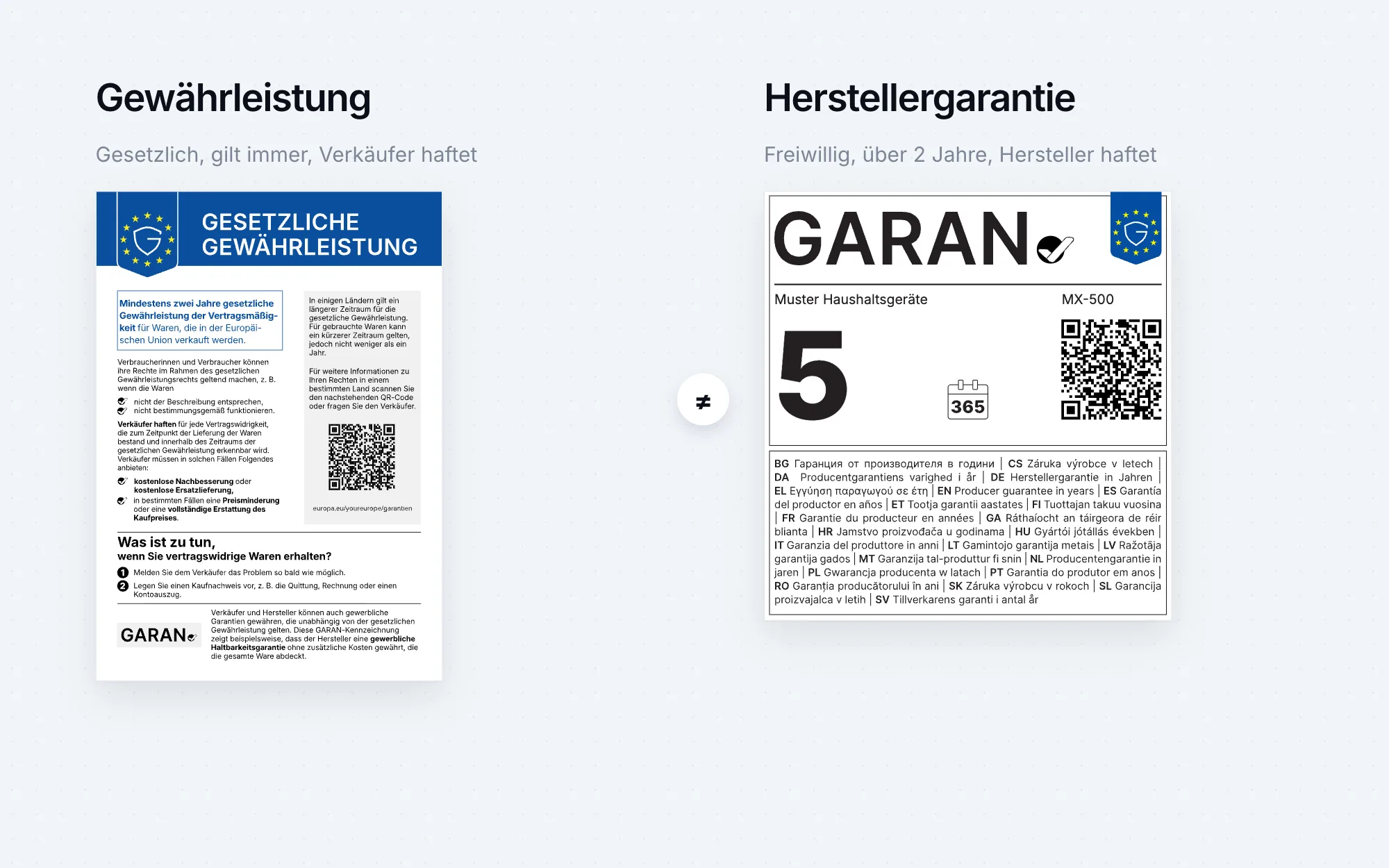
The Commission, through Implementing Regulation (EU) 2025/1960 of 25 September 2025. Art. 22a CRD gives it this task and requires the notice and the label to be “easily recognisable and understandable for consumers and easy to use and reproduce for traders” (Art. 22a(5)). The regulation contains the graphics in Annexes I and II and rules out any change to the notice. More on the page Regulation 2025/1960 explained.
Does the directive also apply to digital products?
Only to a limited extent. The harmonised notice refers expressly to goods. For digital content and digital services, the directive only requires a reminder of the existence of the legal guarantee of conformity, without the official graphic (Art. 6(1)(lb) CRD). Goods with digital elements, such as connected devices, are goods; the notice applies to them, plus the minimum period for software updates where the producer provides this information (Art. 6(1)(lc) CRD).
How is the EmpCo Directive transposed into national law?
Each Member State had to adopt its transposing measures by 27 March 2026 and apply them from 27 September 2026. The Implementing Regulation 2025/1960 applies directly and needs no transposition. Where the provisions sit in national law differs from country to country. Example Germany: the notice and label obligation was transposed by the Act of 3 February 2026 (BGBl. 2026 I No. 28), the unfair practices part by the third act amending the UWG of 12 February 2026 (BGBl. 2026 I No. 43). Both have applied since 27 September 2026.
| Obligation | EU basis | Example Germany |
|---|---|---|
| Legal guarantee notice in shops | Art. 5(1)(e) CRD | Art. 246(1) No. 5 EGBGB |
| Legal guarantee notice in distance selling | Art. 6(1)(l) CRD | Art. 246a § 1(1) sentence 1 No. 11 EGBGB |
| GARAN label | Art. 5(1)(ea), Art. 6(1)(la) CRD | Art. 246(1) No. 5a, Art. 246a § 1(1) sentence 1 No. 11a EGBGB |
| Digital content and digital services | Art. 5(1)(eb), Art. 6(1)(lb) CRD | Art. 246(1) No. 5b, Art. 246a § 1(1) sentence 1 No. 11b EGBGB |
| GARAN directly before the order | Art. 8(2) CRD | § 312j(2) BGB |
The German law, for example, refers expressly to the graphics: the online provision requires the notice “using the harmonised notice under Annex I of Implementing Regulation (EU) 2025/1960 as worded on 25 September 2025”. For in-store sales, the directive allows Member States not to apply the pre-contractual information requirements to day-to-day transactions performed immediately at the time of their conclusion (Art. 5(3) CRD); how far such an exception extends to the notice is unclear. Distance selling has no such exception; the directive only excludes regular delivery rounds of goods for current consumption in the household and automatic vending machines (Art. 3(3)(j) and (l) CRD).
What changes for environmental claims and unfair practices?
The unfair practices part of the directive (Art. 1) mainly targets environmental claims. It adds new practices to the blacklist in Annex I of the Unfair Commercial Practices Directive, including points 23d to 23j on software updates, durability and reparability, for example falsely claiming that a good has a certain durability. The obligation to show the legal guarantee notice, by contrast, is not part of this; it comes from the amendments to the Consumer Rights Directive (Art. 2).
If you advertise with sustainability or durability, have those claims checked separately. They make no difference to the legal guarantee notice itself. What can happen if the notice is missing is explained, using Germany as an example, on our page Abmahnung und Bußgeld (in German).
When does the EmpCo Directive apply to traders?
Since 27 September 2026. Member States had to adopt their transposing measures by 27 March 2026 and apply them from 27 September 2026 (Art. 4(1) Directive 2024/825). Implementing Regulation 2025/1960 became applicable on the same day.
| Date | Step |
|---|---|
| 28 February 2024 | Directive adopted |
| 26 March 2024 | Directive enters into force |
| 25 September 2025 | Implementing Regulation 2025/1960 adopted |
| 3 February 2026 | Example Germany: transposition act (BGB/EGBGB) |
| 27 March 2026 | Transposition deadline |
| 27 September 2026 | Application in all Member States |
| 27 September 2031 | Commission report |
Who is affected by the EmpCo Directive?
Every trader who sells goods to consumers, online and offline. Sales between businesses and between private individuals are not covered by the Consumer Rights Directive. Producers play no part in the notice; they may voluntarily place the GARAN label on the goods or the packaging themselves, but the obligation to show it lies with the trader. Borderline cases such as second-hand goods, marketplaces or dropshipping are covered on the page who is affected?
Common misconceptions about the EmpCo Directive
We come across four misunderstandings in shops particularly often:
- “The notice is only needed for products with a guarantee.” Wrong. It reminds consumers of the legal guarantee of conformity, which applies to all goods (recital 28 Directive 2024/825).
- “Every guarantee needs the GARAN label.” Wrong. Only the producer’s commercial guarantee of durability at no additional cost, covering the entire good, for more than two years. The label must not be used for other guarantees (guidelines, p. 29).
- “The legal guarantee and a commercial guarantee are the same thing.” Wrong. The regulation calls them “two independent types of guarantees” (recital 2 Regulation 2025/1960). More under legal guarantee vs commercial guarantee.
- “You can adapt the notice to your shop design.” Wrong. None of the elements of the harmonised notice can be edited (Annex I, note 1, Regulation 2025/1960).
What do online shops need to do now?
For most shops, it comes down to four points:
- show the official legal guarantee notice in colour and unmodified in your shop, clearly visible before the purchase,
- for products with a producer’s commercial guarantee of durability of more than two years, show the GARAN label next to the product image and directly before the order,
- following the guidelines, also include the notice and the label in the order confirmation,
- for guarantees, keep providing the commercial guarantee statement under Art. 17(2) of the Sale of Goods Directive; the label does not replace it.
On Shopify, the app EU-Gewährleistungslabel, GARAN takes care of this: official original graphics in 24 languages, automatic placement on the product page, in the cart and in the footer, GARAN per product, the graphic with PDF download and the guarantee statement in the order confirmation. Details on the page legal guarantee notice for Shopify.
This page summarises the directive to the best of our knowledge (as of 7 October 2026). Only the official text is authoritative (EUR-Lex). National transposing laws may differ in detail. This page is not legal advice.
Frequently asked questions
What does the EmpCo Directive have to do with the legal guarantee notice?
It is the legal basis. Directive (EU) 2024/825 amended Articles 5, 6, 8 and 22a of the Consumer Rights Directive and thereby introduced the obligation to show the harmonised legal guarantee notice and the GARAN label.
When does the EmpCo Directive apply?
It entered into force on 26 March 2024. Member States had to transpose it by 27 March 2026 and apply their measures from 27 September 2026. The obligation to show the legal guarantee notice has applied since that date.
How is the EmpCo Directive transposed into national law?
Each Member State transposes it into its own consumer law; the provisions and their numbering differ from country to country. Germany, for example, placed the notice and the GARAN label in Art. 246 and 246a EGBGB and § 312j(2) BGB (Act of 3 February 2026, BGBl. 2026 I No. 28) and transposed the unfair practices part by the third act amending the UWG (BGBl. 2026 I No. 43).
Isn’t EmpCo about greenwashing?
That too. Art. 1 of the directive amends the Unfair Commercial Practices Directive, mainly with regard to environmental claims. Art. 2 amends the Consumer Rights Directive and brings the information requirements for the legal guarantee notice and the GARAN label, which affect almost every online shop.
Do producers also have to show the legal guarantee notice?
No. The obligation to show the notice lies with the trader selling to consumers. Producers may voluntarily place the GARAN label on the goods or the packaging themselves (recital 28 Directive 2024/825); the obligation to show it in the shop remains with the trader.